The fastest way to enjoy your first months on the mat is simple: stop making the few mistakes that drain your energy and stall your progress.
Starting brazilian jiu jitsu as an adult is exciting, but it can also feel like learning a new language while doing cardio. In Queens, most beginners come in with the same goals you probably have: get in shape, learn real self-defense, and find a routine that fits a busy schedule. The good news is that you do not need to be naturally athletic to make steady progress.
What you do need is a plan for avoiding the common traps that catch new students. We see these mistakes all the time in our beginner-friendly training room, and they are fixable. In this guide, we will break down the top mistakes beginners make in brazilian jiu jitsu, why they happen, and the practical adjustments we teach so you can train safer, feel calmer, and improve faster.
Why beginners struggle in brazilian jiu jitsu (and why it is normal)
In the beginning, everything feels urgent. Someone grabs your collar, your balance disappears, and your brain tries to solve ten problems at once. That pressure makes people default to instincts: squeeze harder, hold your breath, and move faster. The problem is that those instincts burn energy and create openings.
Brazilian jiu jitsu rewards a different order of operations: posture, base, frames, and position first, then submissions. Once you accept that hierarchy, training gets less stressful. You stop chasing the quick finish and start building control you can actually repeat, even on tired days.
The top 7 beginner mistakes (and the fixes we coach every week)
Mistake 1: Using strength instead of technique
Muscling through positions works for about thirty seconds, and then the exhaustion hits. We often see new students squeeze headlocks, curl their arms in tight, and try to bench press opponents off them. It feels powerful, but it usually makes you tired and stuck.
The fix is to trade effort for structure. We coach you to use leverage, not strain: frames that support your body, hip movement that creates space, and angles that make your opponent carry your weight instead of the other way around. When technique takes over, you can roll longer and learn more per round, which matters in adult training where time is precious.
A simple checkpoint we use: if your neck and forearms are on fire, you are probably overworking. If your skeleton is doing the job, you can breathe.
Mistake 2: Holding your breath and tensing up
This is one of the biggest reasons beginners gas out. You get into a scramble, your shoulders rise toward your ears, and your breathing turns into short, panicky sips of air. After a minute, your arms feel heavy and your decisions get sloppy.
We teach steady breathing on purpose, not as a vague reminder. You should be able to exhale while you frame, exhale while you shrimp, and reset your breath when you find a moment of control. Relaxing does not mean being passive. It means you are not donating energy to unnecessary tension, especially in your hands and shoulders.
If you want a practical cue: keep your jaw unclenched and your shoulders down when you can. That tiny adjustment changes your whole pace.
Mistake 3: Not tapping early enough
Some people hesitate to tap because they worry it looks weak. Others tap late because they do not recognize danger yet. Both are normal beginner issues, and both can lead to injuries that keep you off the mat for weeks.
We treat tapping as communication. Tap early, reset, and ask what happened. You will learn faster that way than you will by trying to survive a tight armbar for an extra second. In brazilian jiu jitsu classes for adults, longevity is the real advantage. When you train consistently without avoidable injuries, you get better, period.
Also, tapping is not losing. It is data. It is how you collect reps safely.
Mistake 4: Skipping fundamentals to chase flashy techniques
You have probably seen highlight clips online. Flying armbars, spinning back takes, and wild scrambles look fun, but they can create a false map of what works for beginners. When you skip the basics, your game becomes a pile of half-learned moves with no foundation.
We build your foundation on fundamentals that show up everywhere:
- Guard retention and recovery so you can stay safe when you are tired
- Shrimping and bridging to escape bad positions without panic
- Framing with your forearms and shins to create space and protect your neck
- Basic posture and base so you stop getting folded and pulled off balance
- Simple positional control from side control, mount, and back control before hunting submissions
These skills are not boring when you feel them working. The first time you escape mount with clean timing, it is honestly a relief.
Mistake 5: Overgripping and burning out your hands
New students grab a gi like it is a lifeline. Or in no-gi, you cling to a head-and-arm squeeze until your biceps cramp. Overgripping makes your arms tired, slows your transitions, and can lead to sore elbows and fingers.
The fix is to grip with a purpose and a time limit. We teach you to ask, what is this grip doing for me right now? If it is not breaking posture, controlling distance, or setting up a move, let it go and move your body instead. Your legs and hips are stronger tools than your hands, and your guard gets dramatically better when you trust that.
A helpful rule: if you cannot explain why you are gripping, you are probably just holding on.
Mistake 6: Leaving elbows and neck exposed
Loose elbows are an invitation to armbars, triangles, and chokes. Beginners often reach wide to push or pull, and that opens the space under the elbow that submissions need. On top of that, many people lead with their head in takedown entries or try to bench press from bottom, putting their neck in a bad spot.
We coach a compact defensive shape. Keep your elbows closer to your ribs when defending, and use frames with your forearms instead of reaching. On the ground, protect the space between your shoulder and your elbow. Standing, think posture first: head up, spine aligned, and hands ready to pummel for inside control.
This does not mean curling into a ball. It means keeping your structure connected so you can move without giving easy openings.
Mistake 7: Treating every round like a competition
If every roll is a win-or-lose moment, your training turns into stress. You rush, you muscle, you avoid positions you are bad at, and you leave class frustrated. That mindset also makes it harder to be a good partner, which matters in a tight-knit community like BJJ in Queens.
We coach you to roll with a goal. Pick one theme for a round: recover guard, defend the crossface, maintain posture inside closed guard, or escape side control using frames and hip movement. When you do that, even a tough round becomes productive because you can measure something real.
Progress in brazilian jiu jitsu is not linear. Some weeks you feel sharp, and other weeks you feel like you forgot everything. That is still progress if you keep showing up.
A simple game plan for your first 30 days
You do not need a huge strategy. You need a repeatable routine that keeps you safe and builds confidence. Here is the approach we recommend for most beginners, especially adults balancing work, family, and NYC commutes:
1. Learn how to breathe and reset when you feel overwhelmed, even mid-round.
2. Drill one escape from bottom and one control on top before adding submissions.
3. Tap early, ask one question after the round, and move on without overthinking it.
4. Focus on positional hierarchy: survive, escape, control, then submit.
5. Train consistently on a schedule you can maintain, not an extreme burst you cannot sustain.
If you follow that for a month, you will feel the difference in your gas tank, your calmness under pressure, and your ability to understand what is happening during live rounds.
What to expect in our brazilian jiu jitsu classes for adults
Adult beginners often worry about two things: getting injured and slowing everyone down. We structure classes to remove both fears. Our coaching emphasizes control, clear safety expectations, and progressive training that meets you where you are, whether you have an athletic background or you are starting fresh.
You can expect a mix of technical instruction, drilling to build timing, and controlled sparring where you can apply the lesson without chaos. We also help you build good training habits quickly: how to warm up your hips and shoulders, how to partner responsibly, and how to pace your rounds so you leave class tired in a good way, not wrecked.
If you are looking for BJJ in Queens that respects adult bodies and adult schedules, our program is built around steady progress, not beating you up.
Take the Next Step
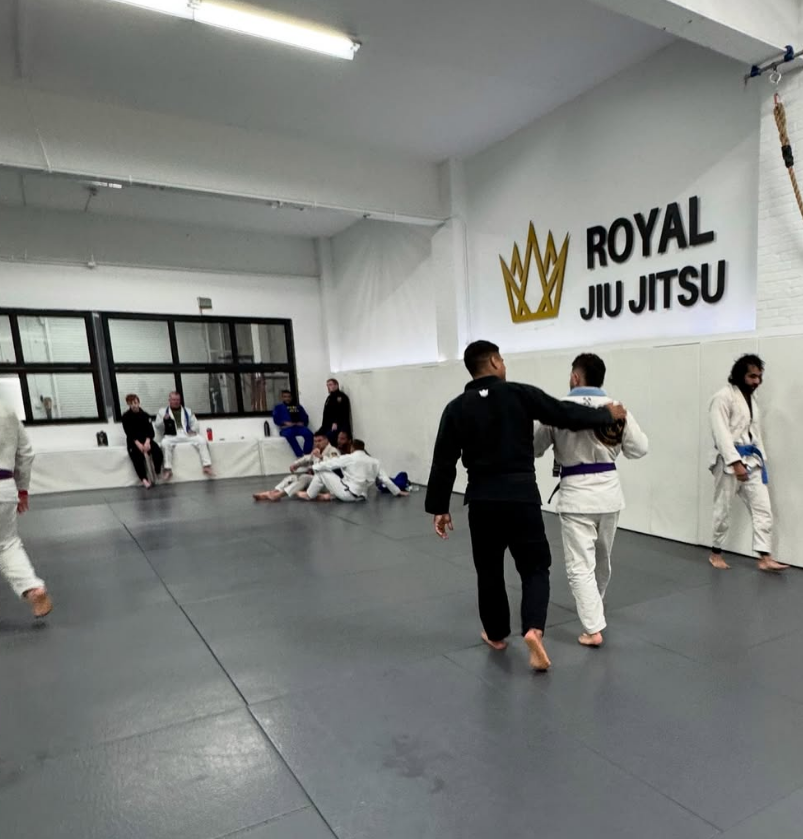
If you want to avoid the classic beginner traps, the best move is training in an environment where fundamentals, safety, and coaching detail are non-negotiable. That is exactly how we run classes at Royal Jiu-Jitsu Queens, and it is why so many new students start feeling more comfortable on the mat within the first few weeks.
Come in with questions, show up consistently, and let us guide the process. Whether your goal is fitness, self-defense, or simply learning something challenging that clears your head after a long day in Queens, we will help you build real skill in brazilian jiu jitsu without the unnecessary frustration.
Train with experienced instructors in a supportive environment by joining a Brazilian Jiu-Jitsu class at Royal Jiu-Jitsu Queens.