The fastest way to enjoy your first class is to stop believing the stories that make starting feel harder than it is.
If you have been thinking about trying brazilian jiu jitsu, you are not alone. We meet plenty of Queens locals who are curious, motivated, and also a little unsure because of what they have heard online or from a friend of a friend. And to be fair, most beginners do not need more hype, they need clarity.
The truth is that brazilian jiu jitsu is one of the most beginner-friendly martial arts when it is taught the right way. Our job is to help you learn safely, build confidence, and get better step by step, without feeling like you have to prove anything on day one.
In Queens, schedules are busy, commutes are real, and people come from every background you can imagine. That is exactly why we structure our training to be practical, welcoming, and realistic for everyday life, not just for people who want to train like full-time athletes.
Why myths about brazilian jiu jitsu stick around
A lot of myths start with a grain of truth. Yes, the sport can be intense. Yes, you will sweat. Yes, there is sparring. But beginners often hear the most extreme version of the story, usually from highlight reels or competition clips, and assume that is what a normal first month looks like.
What you do not see in those clips is the part that actually matters: fundamentals, controlled drilling, clear coaching, and a pace that makes progress sustainable. When you understand how training is structured, most fears shrink quickly.
Myth 1: You need to be in top shape before you start
This myth stops more people than it should. If you are waiting to get fit before you try your first class, you are basically trying to earn the right to begin. We would rather you begin and let the training build your fitness naturally.
In our beginner-friendly classes, we focus on technique first. You will learn how to move, frame, breathe, and stay calm under pressure. That alone improves conditioning over time because you stop wasting energy. It is a surprising feeling the first time you realize you can do more by doing less.
Training also scales. Some days you will push harder, some days you will take it lighter, and both can be productive. Consistency beats intensity almost every time, especially at white belt.
What to expect if you are not “in shape”
You will still be able to train, and you will not be the only one. We regularly work with beginners who:
- Have not exercised in years and want a structured way to restart
- Sit at a desk all day and need movement that feels purposeful
- Want to lose weight but do not enjoy traditional gym routines
- Want stress relief and better sleep as much as fitness
Your starting point is not a problem. It is just information we use to coach you well.
Myth 2: You are too old, too young, too big, or too small
We hear this in every direction. Adults worry they are “too old.” Smaller students worry about size. Bigger students worry about being clumsy. Parents wonder if kids can focus. The reality is that brazilian jiu jitsu is built around leverage, timing, and positioning, so it naturally welcomes variety.
BJJ works precisely because it is not only about who is stronger. You learn how to create angles, manage distance, and use your whole body efficiently. That is why you will see people of different ages and body types progress in meaningful ways.
Age matters in how we pace training, not whether you belong on the mat. If you are older, we emphasize smart movement, tapping early, and building a foundation that protects your joints. If you are younger, we emphasize control, listening skills, and fundamentals that keep training safe and fun.
A Queens-specific reality: you need training that fits your life
A lot of people in our area are balancing work, family, and long days. You do not need an identity shift to train. You need a plan that fits. That is why our approach respects your real schedule, not an imaginary one.
Myth 3: It is only for aggressive fighters or muscle-bound athletes
If your only exposure to BJJ in Queens is a clip of a hard competition match, it is easy to assume the vibe is intense all the time. In real training, the goal is control, not chaos.
Brazilian jiu jitsu is often described as “human chess” for a reason. You are learning to solve problems: how to escape a bad position, how to sweep, how to hold someone safely, how to stay balanced when someone is trying to off-balance you. It is physical, yes, but it is also strategic.
We also coach culture intentionally. A good room feels focused and supportive, not reckless. You should be able to train hard without feeling like someone is trying to “win practice.” When you train with controlled intensity, you get better faster and you actually want to come back.
What “good training” looks like day to day
In most classes, you will spend time on:
- A technical lesson with clear details you can repeat
- Drilling with a partner so your body learns the movement
- Optional positional sparring where you start from a specific scenario
- Regular sparring for students who are ready, with safety rules emphasized
That structure is why beginners can thrive even if you have never done a combat sport before.
Myth 4: You will get injured constantly, or you will have no idea what to do
Let’s separate two fears here. One is injury. The other is confusion.
On injury: any athletic activity has risk, but BJJ can be trained very safely when the room follows good protocols. We prioritize tapping early, partner control, and coaching that helps you choose the right pace. We also teach you how to protect yourself with posture, frames, and smart movement, which is injury prevention disguised as technique.
On confusion: every beginner feels lost at first. That is normal. There are new words, new positions, and you are learning how to move on the ground in a way most adults have not practiced since childhood. The key is having a clear learning path. We teach fundamentals in a way that repeats, connects, and builds.
Here is the part beginners often find reassuring: you are not expected to improvise. Early on, you are learning a few reliable answers to common situations. Over time, those answers become instincts.
A simple way we help beginners feel oriented
We coach beginners to focus on a small set of priorities:
1. Learn how to tap and how to keep training partners safe
2. Build posture and balance so you stop getting folded up
3. Understand a few core positions like guard, side control, mount, and back control
4. Practice one escape, one sweep, and one submission with good mechanics
5. Improve breathing and pacing so you can stay calm under pressure
That is enough to make your first months feel structured instead of overwhelming.
Myth 5: You need experience, special gear, or daily training to make progress
You do not need a martial arts background. You do not need to be “tough.” And you definitely do not need to train every day to improve.
Most adult beginners progress well with two to three classes per week. That frequency gives you repetition without burning you out. The most common mistake we see is going too hard too soon, then needing time off. A steady routine wins.
Gear is simpler than people think, too. If you are training in the gi, you need a gi that fits and basic hygiene habits. If you are training without the gi, you need fitted athletic wear that stays in place. We guide you on what makes sense so you do not overbuy or show up stressed about it.
What matters more than training “all the time”
If you want to get better at BJJ in Queens without making it your entire life, focus on:
- Showing up consistently, even when you feel imperfect at it
- Asking one question after class and applying the answer next time
- Choosing partners who help you learn with control
- Tapping early and saving your ego for something useful
- Tracking small wins, like lasting longer in a position or remembering a grip
That is how skill compounds. It is not flashy, but it works.
A quick reality check: what your first few weeks can feel like
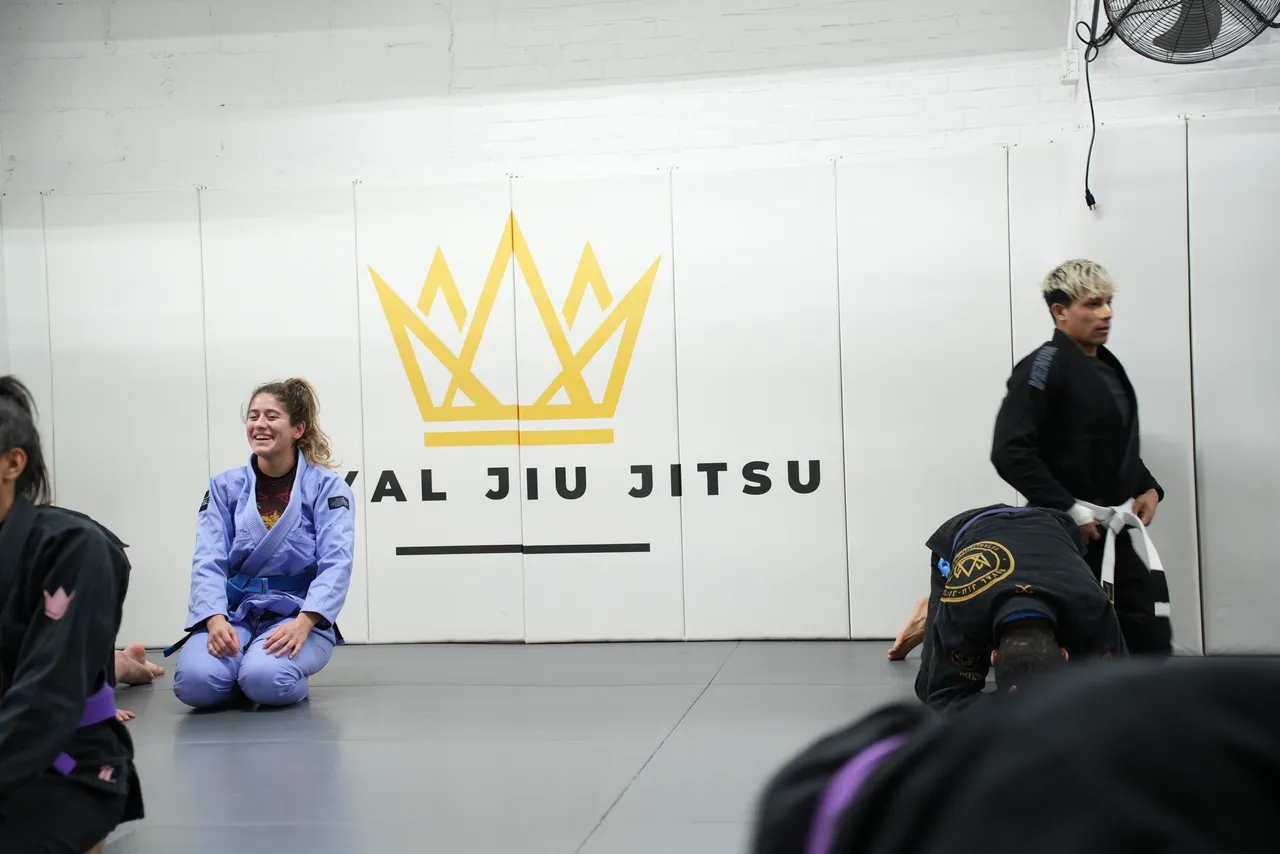
Your first class might feel awkward in a good way. The mats are different under your feet, the room has its own rhythm, and you will probably laugh at least once when you realize how technical everything is. That is normal.
By week two or three, most beginners start recognizing positions. By the end of the first month, you usually have a couple of go-to movements you can rely on, plus a clearer sense of how to train safely. If you stay consistent, your cardio improves, your posture improves, and your stress levels tend to drop. We see it all the time.
And if you are specifically looking for brazilian jiu jitsu in Queens because you want practical self-defense, BJJ gives you a pressure-tested way to manage distance, control someone without striking, and escape bad situations. That confidence comes from practice, not from being fearless.
Take the Next Step with Royal Jiu-Jitsu Queens
If you have been held back by any of these myths, you can let them go without needing to “prepare” first. At Royal Jiu-Jitsu Queens, we keep the learning process clear, safe, and beginner-friendly, so you can focus on building real skill in brazilian jiu jitsu instead of worrying about whether you belong.
If you are ready to try BJJ in Queens for fitness, self-defense, or just a challenging new hobby that actually keeps your attention, we would love to have you in for a class and help you start with a plan that fits your life.
Ready to take what you learned here to the mat? Sign up for a free Brazilian Jiu-Jitsu trial class at Royal Jiu Jitsu Queens today.