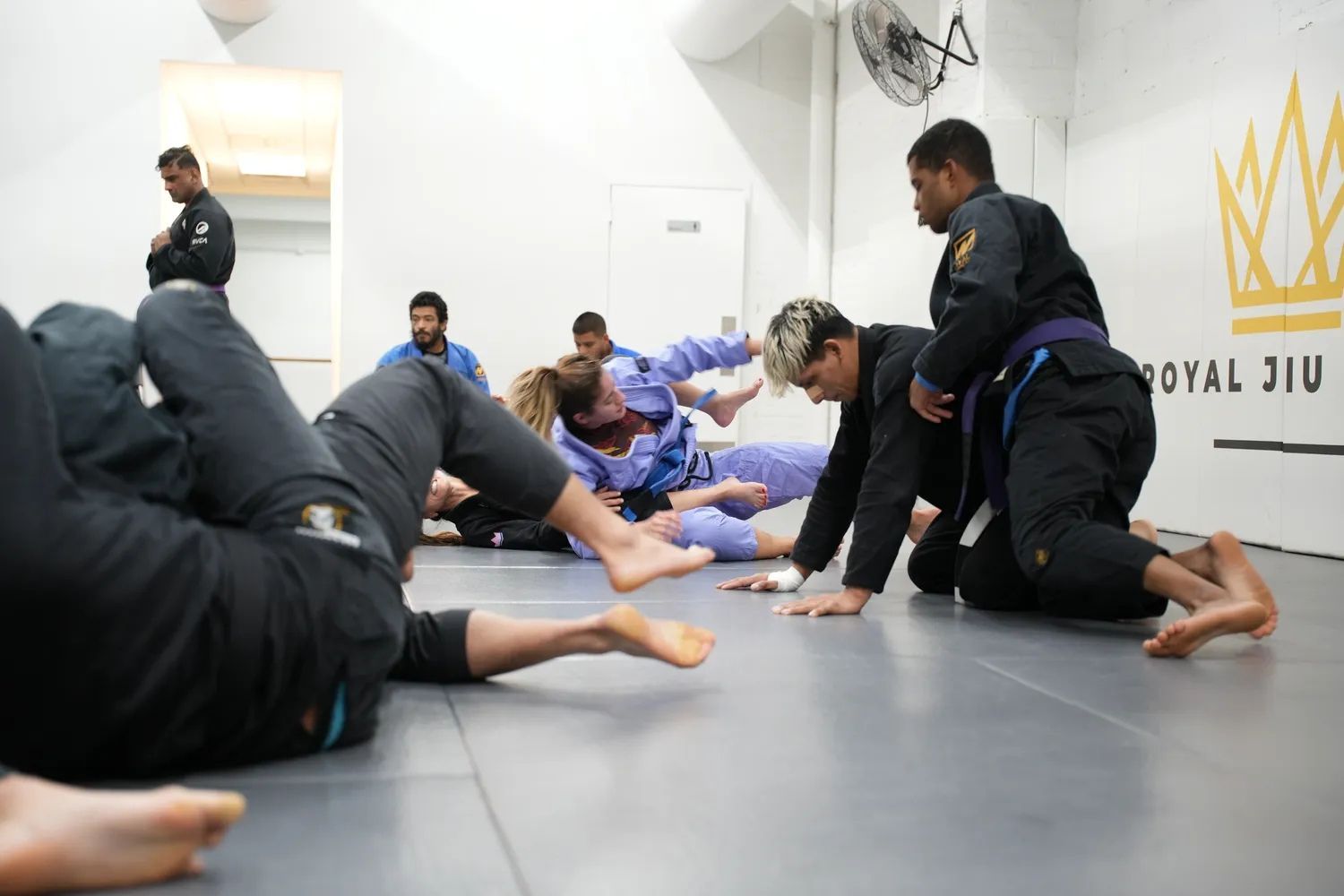
Real confidence is built when your body gets stronger and your mind learns to stay calm under pressure.
Queens moves fast, and most of us feel that pace in our bodies and in our heads. You might be looking for a workout that actually changes how you carry yourself, not just something that burns calories for an hour and disappears the moment you walk out the door. That is where Brazilian Jiu Jitsu fits perfectly, especially when you train consistently and you train with structure.
We see it every week: people start because they want to get in shape or learn self-defense, and they stay because the training builds something deeper. Strength shows up in your grip, your hips, your posture, and your breathing. Self-belief shows up when you realize you can solve hard problems while tired, while being pinned, and while your brain is telling you to quit. That is not a motivational poster, it is just what happens when you learn how to move and think on the mat.
In this guide, we will break down how Brazilian Jiu Jitsu in Queens builds full-body strength and durable confidence, what beginners can expect, and how our classes are designed to make progress feel real and measurable.
Why Brazilian Jiu Jitsu feels different from a normal workout
A lot of workouts are repetitive by design. That can be great for conditioning, but it does not always translate to real-world strength. Brazilian Jiu Jitsu is different because the workout is built into problem-solving. You are using leverage, balance, timing, and controlled intensity with another person, and that changes what your body adapts to.
When you roll or drill, your heart rate rises into aerobic zones and stays there in waves. You are pushing, pulling, posting, bridging, and rotating through angles you rarely hit in a standard gym routine. Over time, that creates strength that feels useful: strong hips, resilient shoulders, a stable core, and legs that do not gas out as quickly when life gets hectic.
And honestly, it is hard to “phone it in” during class. Even on low-energy days, the structure of training pulls you back into focus. That focus is a big reason people report lower stress and anxiety over time. Your mind has a job to do, right now, and there is not much room for background noise.
Brazilian Jiu Jitsu in Queens: strength that is built from the ground up
Queens is diverse, busy, and packed with different lifestyles. We coach commuters who train after work, parents squeezing in evening classes, students building discipline, and adults who want a practical way to feel safer in a high-density environment. The common thread is the need for training that respects your time and delivers results you can feel.
Full-body strength without lifting weights
Yes, you can get stronger without a barbell. In BJJ in Queens, we build strength through resistance, body positioning, and repeated movement patterns that require coordination. The strength you gain tends to be functional: the ability to hold posture, maintain frames, keep balance, and apply pressure in a controlled way.
Here is what that typically looks like in training:
• Pulling strength from gripping and controlling sleeves, collars, wrists, or no-gi ties
• Core strength from bracing while someone tries to off-balance you
• Hip strength from bridging, shrimping, and turning corners to escape or pass
• Leg endurance from staying engaged in guard work and maintaining base
• Neck and upper-back resilience from learning safe posture and pressure management
You do not need to be “strong first” to start. The training builds you up as you go, and you will feel those changes in daily life too, like carrying groceries, climbing stairs, or just standing with better posture.
Cardio and endurance that sneaks up on you
BJJ sessions can be high intensity. Drilling, positional rounds, and rolling elevate your heart rate, and the stop-start nature trains your recovery between bursts. It is a kind of conditioning that feels closer to real life than steady-state cardio.
If your goal is calorie burn and a sweaty, honest workout, you will get it. But the more important part is endurance under pressure: breathing while you are pinned, staying calm while you are tired, and making smart decisions instead of rushing. That is where confidence starts forming.
Flexibility and mobility that are practical, not performative
Flexibility in Brazilian Jiu Jitsu is not about looking impressive. It is about creating angles, staying safe, and moving efficiently. As you practice escapes and guard retention, your hips open up, your thoracic spine rotates better, and your shoulders learn to move through stronger ranges. Mobility becomes a side effect of learning technique correctly.
We also coach movement so you are not just stretching, you are learning how to own those positions. That matters for injury prevention and long-term training, especially if you are starting later in life.
How BJJ builds self-belief, not just skills
Self-confidence can be vague, like something you are “supposed” to have. Self-belief is more concrete. It is the quiet sense that you can handle hard moments. Brazilian Jiu Jitsu builds that through small, repeated wins that stack over time.
The power of tapping out and coming back
If you are new, the idea of “tapping” might sound intimidating. But tapping is one of the healthiest lessons in the sport: you learn to acknowledge pressure, make a safe decision, and reset without ego. That habit is oddly transferable. You stop taking setbacks personally. You start treating them like information.
Over time, you notice changes like these:
• You do not panic as quickly when something goes wrong
• You recover faster after a rough round, physically and mentally
• You can stay present instead of spiraling into frustration
• You can accept coaching without feeling embarrassed
• You start believing you can learn difficult things, because you already are
That is resilience, built in a controlled environment, with training partners who keep the room safe.
Belt progression and measurable growth
Structure matters. In Brazilian Jiu Jitsu, progression is built into the art through belts and stripes, and that is powerful for motivation. You do not need to guess whether you are improving. You can track it through skills you did not have a month ago: a clean hip escape, a guard pass that works against resistance, an escape you can repeat.
We keep our coaching clear and progressive, so you can connect effort to outcome. When you feel that connection, self-belief grows. Not because someone tells you you are capable, but because you prove it to yourself.
Self-defense in Queens: leverage, awareness, and calm decision-making
When people look for Brazilian Jiu Jitsu in Queens, self-defense is often part of the reason. The reality is that street situations are unpredictable, and we never pretend otherwise. But we can train the parts you can control: positioning, balance, distance management, and the ability to stay calm enough to act.
BJJ is known for using leverage rather than brute strength. That makes it especially useful for smaller practitioners, including women and teens, because technique can neutralize size differences when applied correctly. We emphasize fundamentals that matter: base, posture, frames, and escapes. Those are not flashy, but they are the skills that help you survive and create options.
Why grappling skills matter for real life
A lot of confrontations end up in close range. If someone grabs you, clinches, or takes you to the ground, it helps to understand how to protect yourself, how to get back to your feet, and how to create distance safely.
We train these ideas in a controlled, supervised way. You are not thrown into chaos on day one. You build competence step by step, and that gradual exposure is a big reason beginners stick with it.
What to expect in your first classes
Starting something new can feel awkward for about five minutes, and then it usually becomes strangely fun. We keep the environment welcoming and structured, because you learn faster when you feel safe enough to ask questions.
Most beginner-friendly classes follow a simple rhythm:
1. Warm-up that reinforces movement patterns you will use in technique
2. Technique instruction with clear details and common mistakes explained
3. Partner drilling at a pace that matches your experience level
4. Optional positional sparring or controlled rounds as you are ready
5. Quick recap so you leave knowing what to practice next time
You do not need to be in shape before you start. Training is how you get in shape. You also do not need to be fearless. You just need to show up, learn the basics, and give yourself a little time.
What to bring and how to prepare
For most people, the best prep is simple: hydrate, eat something light a couple hours before class, and come with a beginner mindset. If you are worried about looking lost, do not be. Everyone was new once, and we coach beginners constantly.
If you want a small checklist, here is what helps:
• Comfortable training clothes and a water bottle
• Short nails and basic hygiene, which matters more than people expect
• A willingness to ask one question when something feels confusing
• The patience to drill slowly before trying to go fast
• A plan to train consistently, even if it is just two days a week
Consistency is the multiplier. Two solid sessions a week beats one intense session followed by three weeks off.
Building community and accountability in BJJ in Queens
Strength and self-belief do not grow in isolation. One of the most underrated benefits of training is the community that forms naturally when you work hard alongside people who want you to improve. You learn names, you start recognizing familiar games and styles, and you develop trust through safe, respectful rounds.
That community becomes a kind of accountability that does not feel forced. If you miss a week, you feel it, not just in your conditioning, but because you actually like being there. And that matters in Queens, where schedules are packed and it is easy to put yourself last.
We also take pride in keeping our training culture inclusive. You will train with different body types, different ages, and different starting points. That diversity makes you better, and it makes the room feel like Queens: varied, real, and supportive.
How we structure training for long-term results
A common worry is getting stuck or getting injured. Our approach addresses both by keeping fundamentals at the center and layering complexity gradually. You will spend time on posture, base, escapes, guard work, and control positions before chasing fancy techniques. That is not boring, it is what makes your jiu-jitsu reliable.
We also coach intensity. Going hard every round is not a plan, it is just adrenaline. Learning when to slow down, when to breathe, and when to reset is part of becoming skilled. And those habits are exactly what people mean when they say BJJ helps them manage stress in NYC life. You practice calm, repeatedly, in a situation that tries to take it away.
If you are older, returning to fitness, or managing old aches, we can scale training. You can train smart and still get strong. In fact, that is usually the best path.
Take the Next Step with Royal Jiu-Jitsu Queens
If you want a training routine that builds real strength, steady cardio, practical self-defense, and the kind of self-belief that shows up outside the gym, Brazilian Jiu Jitsu is a strong fit for life in Queens. The changes are not instant, but they are noticeable sooner than most people expect, especially when you train consistently and track progress through fundamentals.
We built our classes at Royal Jiu-Jitsu Queens to support beginners and experienced students alike, with clear coaching, a respectful room, and a class schedule that works for busy Queens routines. When you are ready, we would love to help you take that first step and keep building from there.
Build stronger grappling fundamentals and improve your technique by training at Royal Jiu-Jitsu Queens.